
Sort By:
ON REQUEST
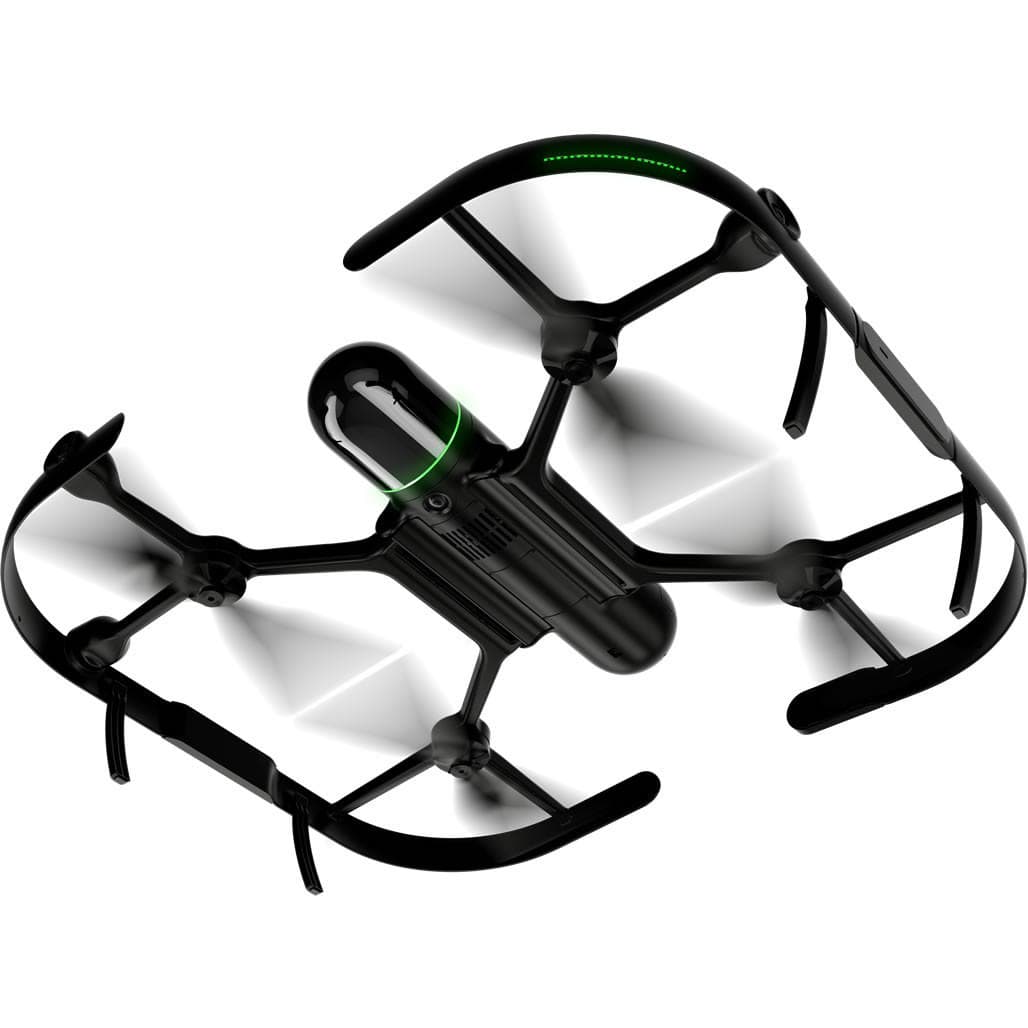
Leica BLK2FLY Autonomous Flying LiDAR Drone Scanner
LeicaBLK2FLY Autonomous Flying Laser Scanner
2026
New
A surveying drone is an unmanned aerial vehicle equipped with specialized sensors, such as high-resolution cameras or LiDAR scanners, to capture georeferenced spatial data from above. These platforms provide a significant technical advantage by delivering high coverage rates and precise ground sampling distances (GSD) through integrated RTK systems. Compared to traditional ground-based methods, utilizing a drone surveying workflow allows for the rapid acquisition of large-scale topographic data with a high return on investment.
Ground sampling distance (GSD): $2-5~cm/pixel$ at 100 m AGL altitude when using a 20 MP sensor.
RTK/PPK horizontal accuracy: $\pm1-3$ cm achievable without the need for extensive ground control points.
Coverage rate: $1-5~km^{2}/flight$ at a standard operating altitude of 100 m AGL.
LiDAR payload point density: $100-300~pts/m^{2}$ at 50 m AGL, ideal for DTM generation and vegetation penetration.
Flight time: 30-55 minutes of operation per battery charge, depending on the payload and environmental wind conditions.
Wind resistance: Capabilities up to $12~m/s$ (Beaufort 6) on professional-grade mapping platforms.
GNSS capabilities: Multi-constellation RTK receiver onboard with support for PPK processing via a base station.
Selecting the appropriate UAV surveying platform requires matching the aircraft to your specific project needs, such as choosing between a fixed-wing WingtraOne GEN II for large-area photogrammetry or a multirotor DJI Matrice 350 RTK for complex LiDAR inspections. Professionals must consider the required GSD and the regulatory environment of the mission site to ensure compliance and data quality. Integrating these aerial units with a high-performance RTK GNSS receiver for ground control ensures the highest level of absolute accuracy.