
Sort By:
Digital Levels
In-Stock
Discounts
Hot
Sort By:
Newest Listing
Sort By:
Digital Levels
What is the difference between a digital level and an auto level?
An auto level uses an optical compensator and requires the operator to read a graduated
staff manually, which can lead to transcription errors. A digital spirit level reads a barcoded
staff electronically, records the data automatically, and eliminates subjective reading
mistakes.
Do digital levels require special staffs?
Yes. Every digital leveller requires a specific barcoded staff that matches the
manufacturer’s optical pattern. These staffs come in different materials, including Invar for
high-precision geodetic work and aluminium or fibreglass for standard construction tasks.
What accuracy is achievable with a geodetic digital level?
A geodetic-grade instrument like the Trimble DiNi 0.3 can achieve a standard deviation of
0.3 mm per kilometre of double-run levelling. This level of precision meets the international
requirements for Class I national vertical control networks and deformation monitoring of
large dams or bridges.
Digital Levels - Professional Surveying
Solutions
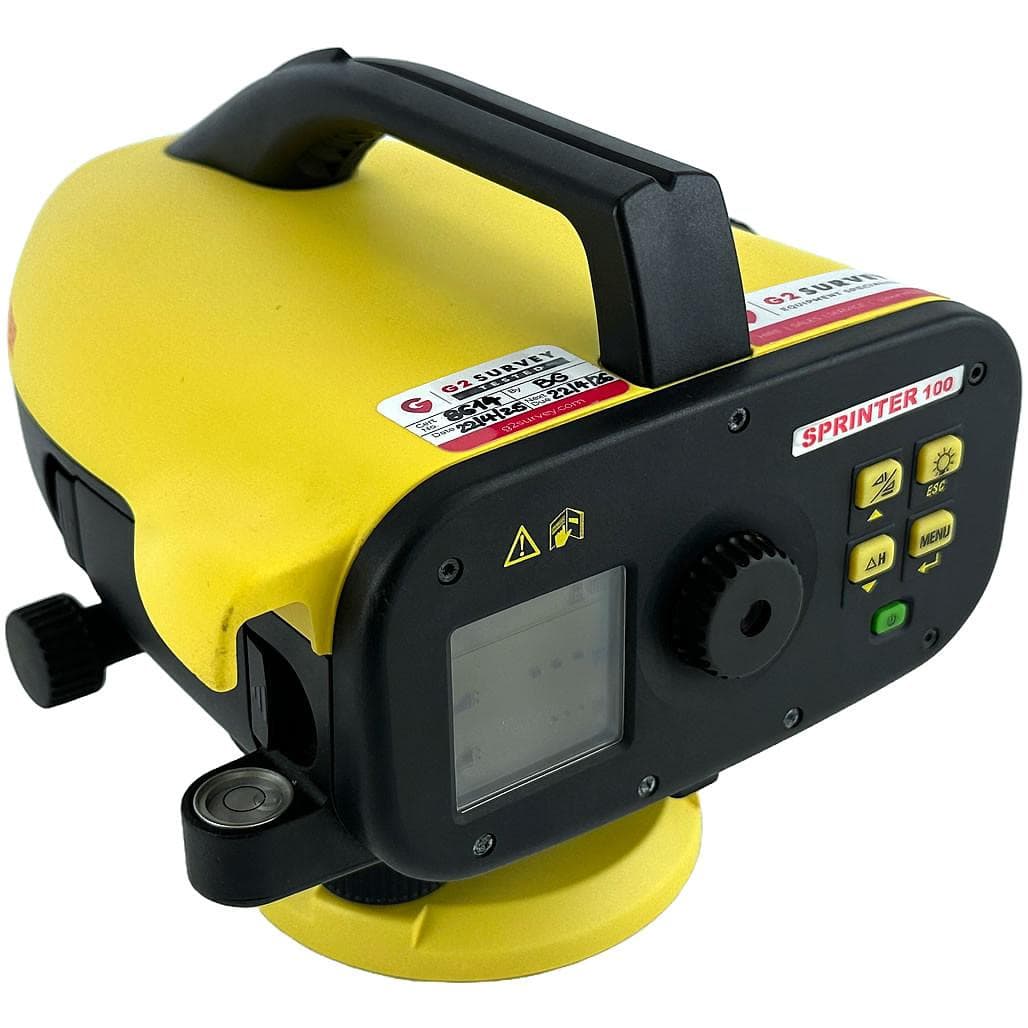
A digital level is a high-precision geodetic instrument that automatically reads a barcoded
staff to determine height differences and distances with electronic accuracy. By replacing the
manual estimation of an optical reticle with a digital image sensor, these devices eliminate
human reading errors and provide instant data storage for complex levelling loops. Modern
digital levelling systems are essential for monitoring structural settlement and establishing
high-order vertical control networks in civil engineering.
Key Features & Specifications
● Height accuracy: $0.2~mm/km$ to $0.7~mm/km$ — provides geodetic-class
precision for double-run levelling on critical infrastructure projects.
● Reading range: 1.5 m to 100 m — supports efficient data collection from close-range
indoor monitoring to long-range outdoor site levelling.
● Measurement time: 3 to 4 seconds — enables rapid observations and significantly
increases field productivity compared to optical instruments.
● Data storage capacity: 2,000 to 30,000 observations — allows for extensive data
logging with direct export via USB or SD card to office software.
● Compensator range: $\pm 10$ to $\pm 15$ arc-minutes — ensures the line of sight
remains horizontal even if the tripod is subject to slight vibrations.
● Environmental protection: IP55 or higher — ensures the internal electronic sensors
remain functional in dusty or damp construction environments.
● Staff compatibility: Invar, fibreglass, or aluminium — supports different grades of
barcoded staffs to match the required precision of the task.
How to Choose the Right Digital Levels
Selecting a digital level requires matching the instrument’s standard deviation to the
specific accuracy requirements of the project. The Leica LS15 is a premier choice for
surveyors who need 0.2 mm precision and integrated autofocus for first-order geodetic
levelling. For general construction layout and site drainage tasks, a more cost-effective
Topcon DL-500 provides sufficient accuracy and ease of use for engineering crews. When
evaluating high precision digital level options, it is vital to ensure that the chosen barcoded
staff material, such as Invar, is compatible with the instrument’s electronic reading system to
maintain the stated accuracy.